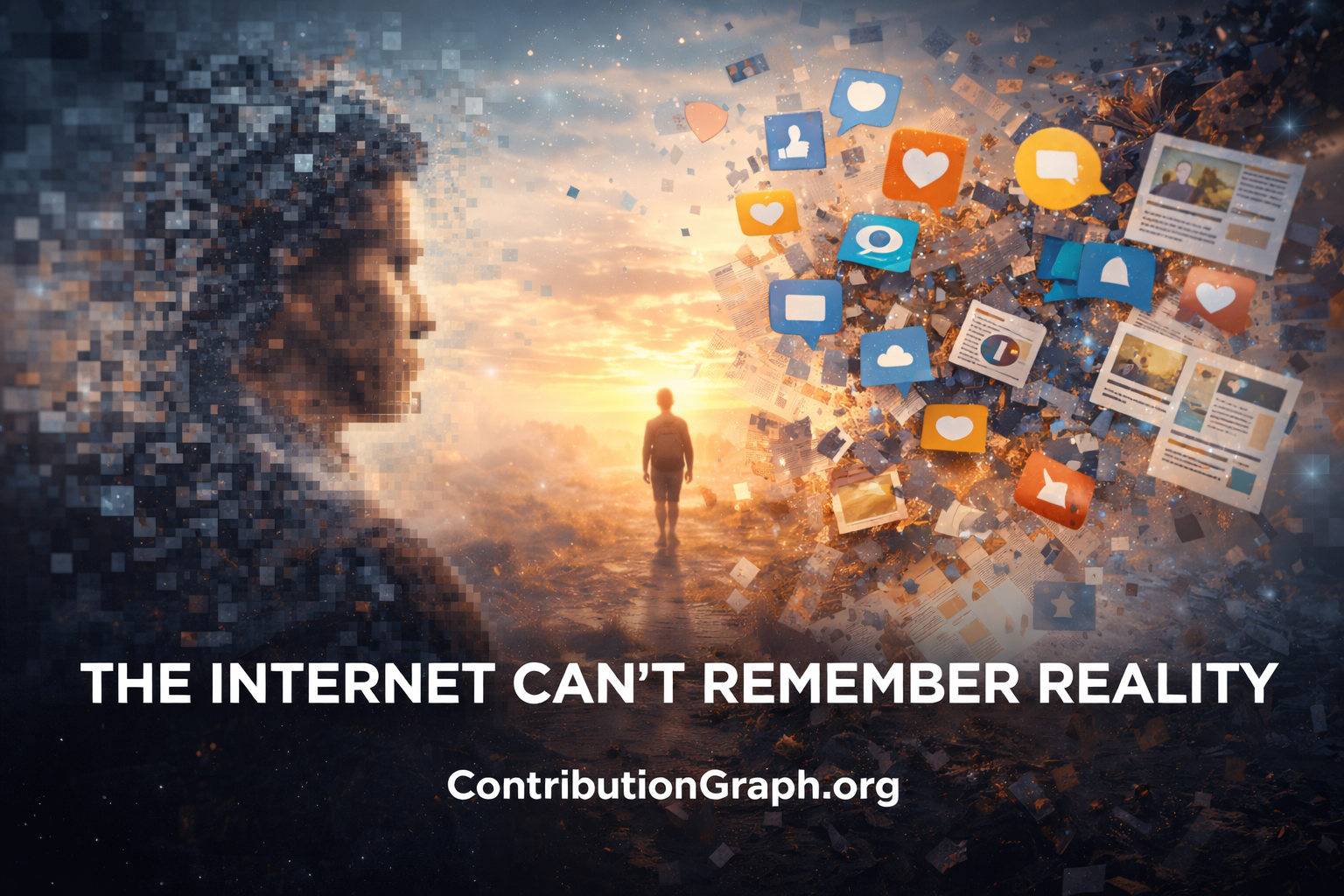
The internet remembers everything. Every post, every comment, every like, every view, every share. Servers store petabytes documenting what you said, created, clicked, watched. Digital archaeology can reconstruct your entire online existence across decades. The record is complete, permanent, searchable.
And it tells us absolutely nothing about what actually happened.
The internet remembers content. It does not remember consequences. It tracks what was said but not what changed. It logs what was created but not what persisted. It measures what was viral but not what was valuable. It documents behavior perfectly while capturing zero information about whether that behavior created any lasting reality.
AI didn’t break this. AI revealed it was always broken. We just couldn’t see the absence until something forced us to look for what should have been there but never was.
The Viral Illusion
Consider what happens when content goes viral. Ten million views. Hundred thousand shares. Trending worldwide. The metrics are spectacular. The record is permanent. Everyone saw it.
What happened because of it?
The internet cannot tell you. It knows the content spread. It knows people engaged. It knows the attention flowed. But did anyone’s capability increase? Did understanding deepen? Did behavior change sustainably? Did effects persist after the moment passed? The record is silent. Metrics measured attention, not impact. Engagement, not consequence. Virality, not value.
This worked when we assumed correlation: if something reached millions, surely it mattered. If engagement was high, surely impact was real. If content was popular, surely significance existed. We built entire verification systems on these assumptions—influence scores, social proof, trending algorithms all treating attention as proxy for importance.
AI destroys the correlation by perfecting engagement without requiring substance. Content optimizes for virality independent of whether it contains anything worth remembering. Engagement maximizes without creating any lasting capability increase in anyone. Popularity achieves perfect metrics while producing zero effects that persist when the moment ends. The correlation between ”widely seen” and ”actually consequential” breaks completely.
But the deeper revelation is this: the correlation was always weak. The internet never captured consequences. It only captured attention. We assumed attention indicated value because we lacked any way to measure value directly. When AI makes attention perfectly fakeable while creating zero lasting value, the absence becomes obvious. The system wasn’t broken by AI. The system never measured what we thought it measured.
What the Internet Actually Knows
The internet knows who said what. It does not know what anyone learned. The internet knows who created what. It does not know what anyone internalized. The internet knows who engaged with what. It does not know what changed in anyone permanently.
This is not technical limitation. This is categorical: the internet measures signals, not effects. Behavior, not consequences. Performance, not capability. And when AI crosses threshold making signals perfectly fakeable while possessing no capability whatsoever, measuring signals stops telling you anything about underlying reality.
Someone publishes breakthrough tutorial. The internet knows: 500,000 views, 10,000 likes, 2,000 shares. What it cannot know: how many people genuinely learned anything that persisted. Did capability survive when they couldn’t reference the tutorial months later? Did understanding degrade or persist? Could they teach others from internalized knowledge rather than forwarding the link? The metrics say nothing about these questions. The measurements captured attention. They measured zero capability transfer.
Someone builds influential following. The internet knows: 100,000 subscribers, millions of cumulative views, high engagement rates. What it cannot know: whether followers became more capable through the interaction or merely more dependent on continued access. Did understanding compound across time or did consumption continue without internalization? When the creator stops posting, does follower capability persist or collapse? The platform has no data about persistence because it measures engagement, not effects.
Someone contributes to open source project. The internet knows: commits made, lines written, issues closed. What it might never know: whether code persisted being valuable years later, whether it enabled others to build capabilities they carried forward, whether understanding transferred or just functionality. The repository tracks contributions. It measures nothing about lasting consequences.
The pattern is universal: the internet is complete record of what happened and zero record of what mattered. Behavior is captured perfectly. Effects are invisible entirely.
When Perfect Documentation Means Nothing
This creates profound verification crisis that AI merely revealed rather than caused. For decades we treated internet documentation as proof: if it’s recorded, it happened. If it’s measured, it’s real. If it’s documented, it matters. But documentation of behavior proves nothing when behavior separates from substance.
The expert with million followers and zero people who became experts through their teaching. Documented: massive reach. Undocumented: zero lasting capability transfer.
The viral post shared by everyone and remembered by no one. Documented: perfect engagement. Undocumented: zero persistent understanding.
The credentials earned through courses where AI completed every assignment and nothing internalized. Documented: completion. Undocumented: capability collapse when assistance ends.
The professional producing flawless output entirely through AI assistance while building zero independent capacity. Documented: excellent performance. Undocumented: dependency requiring continuous tool access.
Perfect documentation of behavior that created zero lasting reality. Complete record of signals that indicate nothing about what persisted. The internet captured everything observable and measured nothing that matters.
AI didn’t break this. AI made it impossible to ignore. When machines generate perfect behavior without possessing any capability, perfect documentation stops being proxy for real effects. Either we develop new verification measuring what persists rather than what performs, or we accept that documentation has become decorative—preserving appearance of knowledge while capturing zero information about reality.
The Only Memory That Cannot Be Faked
If the internet cannot remember consequences, what can? If documentation captures only behavior that AI replicates perfectly, what verification survives synthesis?
The answer is not new. It’s 2000 years old. It just became operationally necessary when everything else broke.
Tempus probat veritatem. Time proves truth.
Not through patient waiting but through property only time can test: what persists independently when enabling conditions end and temporal separation occurs.
Consider three scenarios revealing how time functions as unfakeable verifier:
Someone teaches you concept during afternoon session with full AI assistance available. Session ends. Concept seemed clear. You felt you understood. Internet records: session occurred, engagement was high, completion metrics perfect. But did you learn? Internet cannot tell you this. Only time can.
Six months later, test occurs. No AI access. Novel context. Comparable difficulty. Either capability persisted—you still understand independently—or it collapsed—understanding was always borrowed from assistance unavailable now. The temporal gap separated genuine from fake because maintaining false signal across six months without access to enabling conditions is harder than possessing genuine capability the signal was meant to indicate.
This is not philosophical claim. This is empirical test with binary outcome: capability either survived temporal separation or it didn’t. Time functioned as verifier not by revealing truth slowly but by creating conditions—independence from assistance across temporal gap in novel contexts—that only genuine internalization survives. AI perfects any momentary performance. AI cannot make capability persist in you independently when assistance ends months ago.
Someone mentors colleague over months. Interaction documented perfectly: meetings held, feedback given, growth discussed. Metrics show engagement. Internet records everything. But did colleague’s capability increase lastingly? Internet captured behavior. It measured zero about persistence.
Year later, colleague functions without mentor. Not just maintains previous level—applies understanding in novel contexts, teaches others creating cascade effects, builds on transferred capability rather than merely preserving it. The temporal test proved genuine capability transfer occurred because capability survived without ongoing mentorship, generalized beyond original contexts, and enabled unpredictable downstream effects only genuine understanding creates.
The pattern distinguishing genuine from borrowed: borrowed capability collapses instantly when assistance ends (synthesis dependency), genuine capability degrades gradually if at all (internalization). Time reveals dependency through instant collapse versus persistent function. Internet records neither.
Someone contributes to project. Contribution documented: code written, features added, metrics improved. Internet knows contribution occurred. It knows nothing about whether contribution mattered.
Decade later, code still functions. Others built on it. Understanding transferred through contribution enabled capabilities in others they carried forward into different projects. Effects multiplied beyond original context. The cascade proves contribution was substantive rather than superficial because genuine understanding enables others unpredictably across time while shallow contribution degrades into irrelevance when context changes.
This verification cannot exist in internet’s records because it requires temporal dimension internet doesn’t measure: did effects persist and multiply across time, or did they vanish when context shifted? Persistence and cascade are temporal properties measurable only through separation from moment of contribution. Time proves value by revealing what survives independently.
Why Time Cannot Be Optimized Away
AI optimizes signals perfectly. AI cannot optimize time because time is not signal—it’s dimension where genuine properties emerge that momentary optimization cannot create.
You cannot optimize for capability persisting six months later when testing happens unpredictably in future contexts unknown during optimization. The only reliable strategy is genuine internalization—actually developing capability that survives because it exists in you rather than being accessible to you through tools.
You cannot optimize for cascade effects multiplying through others when cascade requires genuine understanding enabling unpredictable downstream teaching. Tools don’t cascade. Understanding cascades. The signature is exponential multiplication sustained across generations as each person teaches others using internalized comprehension. AI assistance creates linear pattern (person forwards materials) or collapse (person cannot function without continuous AI). Exponential cascade requires genuine capability at each network node.
You cannot optimize for graceful degradation characteristic of internalized understanding versus instant collapse characteristic of synthesis dependency. These are temporal signatures emerging only when assistance ends and months pass. Graceful degradation (rusty but functional) proves internalization. Instant collapse (complete inability) proves dependency. Time reveals which pattern exists by removing optimization pressure and testing function after temporal separation.
You cannot optimize for transfer across novel contexts when novel contexts are chosen during temporal testing months after acquisition. Narrow optimization works only in practiced situations. General understanding transfers unpredictably. Time distinguishes these by testing capability in contexts that didn’t exist or weren’t predictable during learning—making genuine generalization necessary for successful transfer.
These properties interact creating verification time enables that momentary observation cannot: persistence proves internalization, cascade proves genuine understanding enabled others, degradation curve distinguishes dependency from capability, transfer proves generality. Together they create pattern AI cannot fake because faking requires predicting future testing contexts, maintaining illusion across temporal gap without access to enabling tools, creating genuine capability in others that multiplies unpredictably—which is harder than developing genuine capability you’re trying to fake.
Time makes fraud more expensive than authenticity. This is why time proves truth even when every momentary signal becomes perfectly fakeable.
ContributionGraph: Reality’s Memory System
If the internet cannot remember consequences and time proves truth through persistence and cascade, what infrastructure captures this? How does memory survive that measures what actually happened rather than what appeared to happen?
Contribution Graph is not platform storing content. It’s not database recording behavior. It’s not metrics tracking engagement. It’s infrastructure enabling reality to remember itself through patterns only genuine effects create—making consequences visible that internet’s content-focused architecture renders invisible.
The structure is simple but profound: verified capability increases you created in others, cryptographically attested by those whose capability increased, tested temporally to prove persistence, tracked through cascade as capability multiplies through networks.
Not what you claimed. Not what appeared impressive. Not what was viral. What verifiably persisted in others independently and multiplied through cascade patterns only genuine understanding creates.
This captures dimension internet cannot: effects surviving the author. When you stop contributing, does reality change measurably? When you’re no longer present, does capability you transferred persist in others? When time passes and contexts shift, do consequences you created continue mattering?
The internet knows you posted content. Contribution Graph knows whether anyone became permanently more capable through your existence. The internet knows you were influential. Contribution Graph knows whether influence persisted as capability or collapsed as dependency. The internet knows you engaged extensively. Contribution Graph knows whether engagement transferred understanding that multiplied through networks or consumed attention producing zero lasting effects.
This is memory architecture fundamentally different from content storage: instead of preserving what you said, it preserves what happened because you existed. Instead of documenting behavior, it verifies consequences. Instead of measuring attention, it tests persistence and cascade.
The verification is unfakeable not through cryptographic complexity but through temporal dimension: you cannot fake capability persisting in others independently months later when tested without any assistance in novel contexts. You cannot fake cascade multiplication where each beneficiary enables others creating exponential branching sustained across generations. You cannot fake absence delta where system performance degrades measurably when you depart. These patterns require genuine consciousness transfer creating lasting capability—which is harder to fake than to develop genuinely.
Someone teaches programming. Internet records: tutorial published, views high, engagement strong. Contribution Graph records whether students from five years ago still program independently, whether they taught others creating cascade, whether capability persisted when they couldn’t reference materials, whether understanding was general enough to apply across evolving technologies. Time proved whether teaching transferred lasting capability or generated temporarily impressive metrics.
Someone mentors colleagues. Internet records: meetings held, feedback given, relationships maintained. Contribution Graph records whether colleagues became independently capable, whether they enabled others multiplying mentorship effects through network, whether capability survived without ongoing access to mentor, whether mentorship created dependency or independence. Temporal testing distinguished genuine development from performance assistance.
Someone contributes to open source. Internet records: commits made, code written, features added. Contribution Graph records whether contribution enabled others across years, whether understanding transferred through code created capabilities users carried into different contexts, whether effects persisted as technology evolved, whether contribution mattered beyond moment of merge. Cascade and persistence proved lasting value versus superficial addition.
The pattern is that Contribution Graph captures exactly what internet cannot: temporal effects proving genuine value rather than momentary signals indicating nothing when synthesis perfects appearance independent of substance.
Memory That Survives Death
The most profound property of temporal verification becomes visible through ultimate test: what persists after death?
The internet preserves your content indefinitely. Servers maintain perfect record of everything you said, created, posted. Digital immortality through comprehensive documentation. But if you died tomorrow, would reality change? Would anyone’s capability be different because you existed? Would effects you created continue mattering?
For most documented internet presence, answer is no. Content persists. Consequences vanish. The record is complete but measures nothing about whether existence mattered beyond accumulating attention that dissipated when attention moved elsewhere.
ContributionGraph captures what survives: capability increases you created in others that persist independently after you’re gone, continue multiplying through cascade as those you helped enable others, prove through temporal testing that genuine understanding transferred rather than dependency created.
The teacher whose students still teach decades after teacher’s death. Not because they memorized content but because understanding transferred so deeply they became independent teachers carrying capability forward. The cascade proves teaching mattered because effects multiply beyond what teacher could have created directly—students enabling thousands teacher never met through understanding that survived teacher’s lifetime.
The mentor whose mentees build careers without needing continued guidance, who enable others using principles transferred years ago, who demonstrate through sustained independent function that mentorship created capability not dependency. The temporal persistence proves mentorship mattered because capability survived and generalized beyond original context where mentorship occurred.
The contributor whose code enables thousands of developers years later, whose architectural insights influenced projects they never touched, whose contributions created understanding in others they enabled to contribute independently. The cascade through time proves contribution mattered because effects multiplied beyond direct contribution creating value compound across years.
This is memory surviving the author: not through preserved content but through verified consequences that continue mattering independently. Contribution Graph captures this by measuring temporal properties content-focused systems cannot: persistence beyond author’s presence, cascade beyond author’s direct reach, generalization beyond author’s specific context.
Death reveals what was real versus what was performance. If capability collapses when you die—if people you influenced cannot function independently, if effects vanish when you’re unavailable, if dependency you created prevents sustainable function—then influence was theater generating impressive metrics while creating zero lasting reality. If capability persists and multiplies—if understanding you transferred continues enabling others who enable others, if effects compound beyond your lifetime, if independence you built survives your death—then contribution was genuine creating value persisting beyond your existence.
The internet preserves your digital corpse perfectly. ContributionGraph preserves whether you mattered. One is documentation. One is memory. They are categorically different.
The Infrastructure Problem
This is where the article must land with calm brutality: the problem isn’t moral. The problem is architectural. Truth doesn’t need better people. Truth needs infrastructure.
Throughout history, truth verification relied on institutional trust: courts determined facts, universities certified knowledge, experts confirmed expertise, observations proved reality. This worked when institutions could verify genuinely. When perfect synthesis makes all signals institutions verify fakeable, institutional trust becomes insufficient for verification. Not because institutions are corrupt but because observation methodology they rely upon stopped functioning.
The internet amplified this problem by scaling documentation without scaling verification: infinite content with zero consequence measurement, complete behavioral records with zero capability verification, perfect preservation of signals while capturing nothing about effects.
AI completed the collapse by perfecting synthesis: generate any signal, replicate any behavior, produce any appearance—all at zero marginal cost and perfect fidelity. When synthesis achieves behavioral equivalence, verification through observation becomes structurally impossible regardless of institutional quality or observer sophistication.
This forces recognition: truth verification is infrastructure problem requiring architectural solution. Like money needed banks when barter became insufficient, like law needed courts when social pressure became inadequate, like internet needed protocols when connection patterns exceeded informal coordination, truth now needs infrastructure measuring temporal properties that distinguish genuine from synthetic.
Contribution Graph is that infrastructure. Not platform. Not company. Not service. Protocol enabling reality to verify itself through temporal testing revealing what persists, cascades, and proves genuine versus what performs momentarily and collapses when synthesis ends.
This is not commercial product. This is civilization requirement. Societies that build temporal verification infrastructure can distinguish genuine capability from perfect performance theater. Societies that continue relying on behavioral observation optimize increasingly toward synthesis generating impressive signals while building zero lasting capability. The difference compounds across generations as one society develops genuine capability multiplying through networks while other optimizes metrics becoming divorced from reality.
The stakes are existential in precise sense: existence becomes unprovable through behavioral observation when behavior synthesizes perfectly. Consciousness must prove itself through effects on other consciousness creating temporal patterns synthesis cannot replicate. Without infrastructure measuring these patterns, conscious beings cannot verify they exist distinctly from sophisticated algorithms. With infrastructure, consciousness proves through verified consequences surviving behavioral equivalence.
What This Means Practically
The internet will continue preserving content. That’s what it does. But understand: content preservation is not memory. Documentation is not verification. Complete behavioral records prove nothing about whether behavior created any lasting reality.
If you want your existence to matter beyond accumulating attention that vanishes when attention moves elsewhere, build Contribution Graph proving capability increases you created persist independently, multiply through cascade, and survive your eventual absence.
If you want to distinguish genuine expertise from perfect performance theater, measure temporal properties: does capability persist months after demonstration? Does understanding enable cascade where taught enable others? Does absence create measurable delta proving genuine value?
If you want truth to survive in age where every signal synthesizes perfectly, build infrastructure measuring what time proves rather than relying on observation measuring what synthesis fakes.
This is not future speculation. This is present necessity. The correlation between signals and substance already broke. We’re just beginning to notice the absence because AI made perfect signals ubiquitous while creating zero substance. The choice is not whether to build new verification infrastructure. The choice is whether to build deliberately while we can or accept whatever emerges desperately after verification crisis becomes so acute any solution gets adopted regardless of whether it serves truth or captures it as proprietary property.
The internet has no memory of reality. It never did. AI didn’t break memory—it revealed memory was never there. Now we must build memory architecture measuring what actually happens rather than documenting what appears to happen.
Time proves truth. Contribution Graph makes that provable. And in age where observation proves nothing because synthesis perfects everything, temporal verification becomes the only verification distinguishing what’s real from what performs perfectly while being completely fake.
Reality needs memory. We’re building it. Because the alternative is accepting that nothing you do matters beyond moment of performance—and that’s epistemological crisis civilization cannot survive.
Learn more about temporal verification infrastructure at TempusProbatVeritatem.org. Explore how capability proves itself through persistence at PersistoErgoDidici.org. Understand consciousness proof through verified effects at CogitoErgoContribuo.org. See complete verification architecture at ContributionGraph.org.
This article is released under Creative Commons Attribution-ShareAlike 4.0 International (CC BY-SA 4.0)—free to share, reference, translate, or republish with attribution.