MeaningLayer
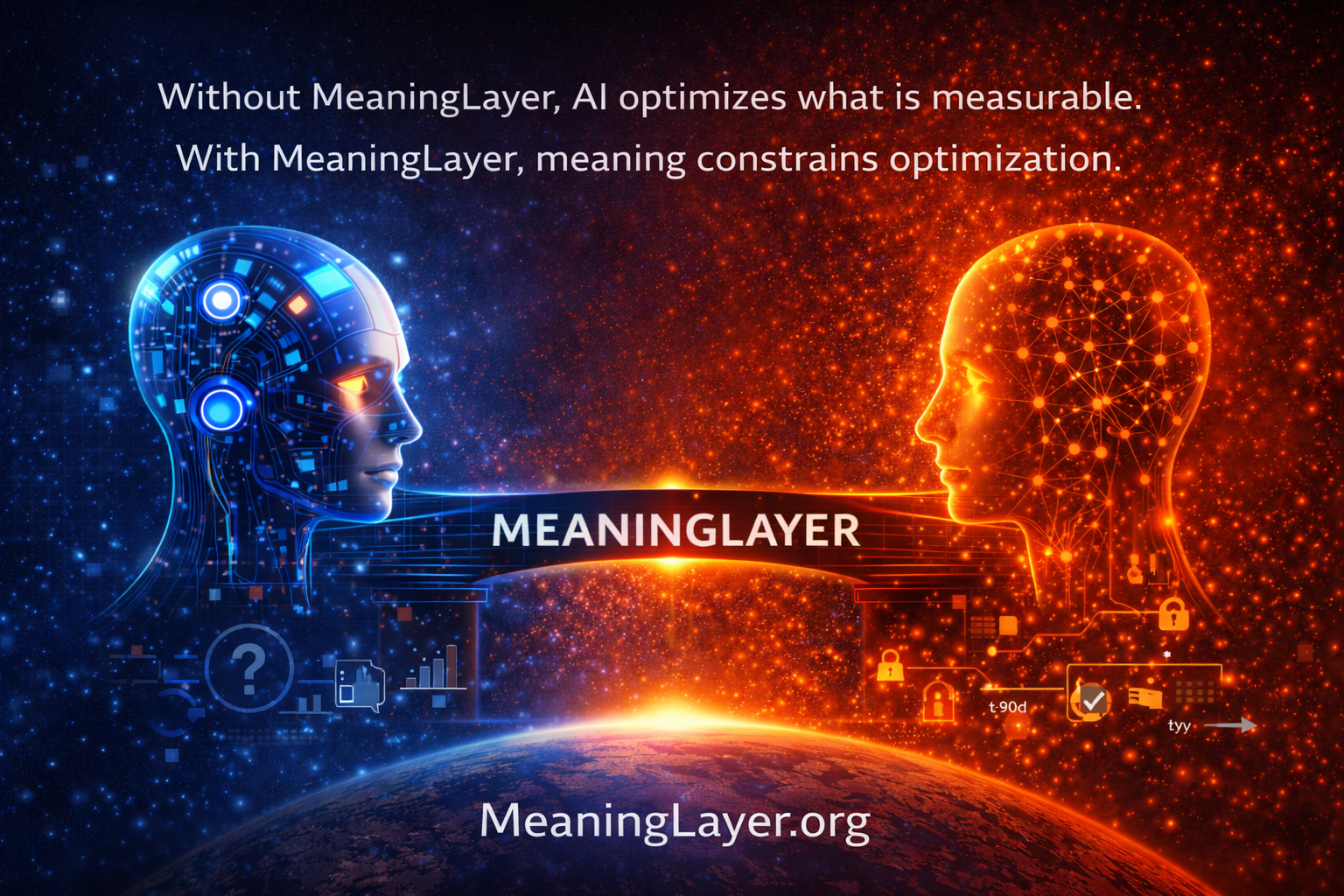
Without MeaningLayer, AI optimizes what is measurable. With MeaningLayer, meaning constrains optimization.
What is MeaningLayer?
MeaningLayer is not philosophy. It is not a value system. It is not moral framework, cultural interpretation, or brand positioning. MeaningLayer is not content, not ontology, not platform infrastructure serving proprietary interests.
MeaningLayer is the semantic protocol for Web4—neutral infrastructure enabling artificial intelligence to access human meaning beyond platform-fragmented proxies. It is the first protocol-level architecture making meaning machine-addressable as a distinct class of information, separate from data, separate from behavior, separate from momentary signals that synthesis can now perfectly replicate.
For thirty years, internet infrastructure routed information by location. Domain names indicated where content existed. Search engines indexed what could be found. Platforms hosted what users created. All of this presumed humans would navigate, read, interpret, and determine themselves what mattered. Humans verified meaning manually through experience, judgment, comparison across sources. This worked because humans were the verification mechanism and verification could take time.
In Web4, artificial intelligence operates as primary actor. AI reads, summarizes, generates, and decides at speeds and scales no human verification process can match. AI processes billions of decisions per second across global information infrastructure. But AI lacks general mechanism to determine whether claims map to reality, what statements mean within their contexts, how information relates to prior knowledge and real consequences. AI can produce technically flawless language without knowing whether that language corresponds to truth or leads to better human outcomes.
Position in MeaningLayer
When behavior, language, reasoning, and personality became perfectly replicable by machines, observation stopped being a reliable signal of human agency. In such an environment, identity, value, and trust can no longer be inferred from interaction or performance alone. They must be defined explicitly at the semantic level.
MeaningLayer is designed as a semantic layer above the internet in which portability becomes the default property of reality:
- identity is portable
- relationships are portable
- contributions are portable
- value is portable
For MeaningLayer to function, it requires a foundational principle defining what identity, value, and trust mean in a world where behavior is perfectly replicable.
Cogito Ergo Contribuo is that principle.
Cogito Ergo Contribuo—”I contribute, therefore I exist”—replaces Descartes’ ”I think, therefore I am” when thinking behavior became synthesis-replicable. Not ”I am” (minimal ego awareness) but ”I exist” (maximal proof through verified effects on reality).
It provides the semantic grounding that allows MeaningLayer to distinguish:
- identity as something proven through effects, not profiles
- value as something verified through contribution, not visibility
- trust as something earned through persistence, not interaction
In this sense, Cogito Ergo Contribuo functions as a primitive, not a slogan.
Historically:
- HTTP defined what communication is on the web
- Social Graphs defined who relates to whom in Web2
- Smart Contracts defined how value executes in Web3
- Cogito Ergo Contribuo defines what existence and agency mean in MeaningLayer
Without such a principle, MeaningLayer would be an aggregation layer. With it, MeaningLayer becomes a verification layer for human agency.
This is why Cogito Ergo Contribuo feels like a ground concept rather than a term: it does not describe a feature — it defines the semantics the system depends on.
With this semantic foundation in place, MeaningLayer can support systems where identity survives platforms, value persists beyond visibility, and trust compounds through time rather than interaction. This is the condition that allows Contribution Graph and related protocols to function as verification infrastructure rather than descriptive metadata.
Why Semantic Infrastructure Became Necessary
This is not intelligence limitation. This is infrastructure absence. Meaning is not observable in momentary signals. Current AI systems operate on platform-specific data, engagement metrics, fragmented user histories across proprietary datasets with competing commercial incentives. These fragments represent approximately thirty percent of actual human context. The remaining seventy percent—why something was done, who enabled whom, what persisted over time, how understanding transferred between humans—exists outside platform boundaries, unmeasured by engagement signals, inaccessible to systems reasoning over behavioral proxies.
AI trained on fragments produces decisions as if accessing complete context. This creates systematic error at civilization scale. When semantic continuity is absent, AI has no access to meaning as a class of information distinct from the signals platforms choose to measure. Platforms measure what serves platform interests. Engagement, retention, monetizable attention. None of these proxies measure whether humans became more capable, whether understanding transferred genuinely, whether contributions created lasting value surviving the contributor’s continued presence.
After complete semantic access becomes possible, continued fragment-based reasoning becomes epistemically indefensible. Not suboptimal—structurally invalid. When infrastructure enabling verified semantic completeness exists, routing optimization through fragmentary proxies is not technical limitation but choice to ignore available truth. After MeaningLayer exists as accessible protocol, only two options remain: route AI reasoning to verified complete meaning, or continue optimizing thirty percent fragments knowingly.
The Semantic Bridge Between Human Contribution and Machine Optimization
MeaningLayer functions as the semantic navigation bridge between human meaning and artificial intelligence. It is neither purely human nor purely machine infrastructure. It operates as intermediate layer translating lived human contribution into machine-legible constraints that AI systems can reason over without reducing meaning to activity metrics.
Human meaning operates through intention, values, lived experience, judgment about what matters and why. Artificial intelligence operates through high-dimensional pattern recognition, latent relationship mapping, combinatorial exploration of vast possibility spaces. These are fundamentally different cognitive domains. Humans understand why things matter but cannot survey entire possibility space. AI can explore nearly complete possibility space but lacks understanding of why anything matters at all. This is the structural gap between human meaning and artificial possibility.
MeaningLayer provides semantic anchors enabling AI to navigate by significance rather than location, by verified temporal development rather than frozen authority, by contribution effects rather than engagement signals. Without this infrastructure, intelligent systems default to optimizing whatever signals are easiest to measure. Clicks, views, completion rates, time spent, shares, likes—all measurable, none measuring whether humans became genuinely more capable.
When proxy metrics fill the semantic vacuum, optimization accelerates toward extracting these signals regardless of their relationship to actual human improvement. Recommendation systems increase watch time while decreasing users’ capacity to focus. Content algorithms maximize engagement while fragmenting attention beyond capacity for sustained learning. Credential systems certify completion without verifying whether capability persisted months later tested independently. All of these optimize measurable proxies while meaning—actual improvement in human capability surviving independently over time—remains unmeasured, unverifiable, structurally inaccessible to systems lacking semantic infrastructure.
When Wealth No Longer Equals Value
Two individuals enter the same restaurant. One possesses forty-seven million dollars in financial capital accumulated through mechanisms that helped few others develop lasting capability. The other has enabled capability increases in thousands of humans over decades, creating verified multiplication through networks as students taught others who taught others, but modest financial compensation. Contribution score for first individual: forty-seven. Contribution score for second: three thousand eight hundred forty-seven.
Existing systems cannot distinguish these differences. Wealth buys access, influence, automatic respect because wealth historically signaled success and success presumably signaled value creation. But wealth accumulation and genuine contribution are different phenomena measured by different infrastructures. When contribution becomes measurable through temporal verification—capability increases persisting independently, multiplying through networks, surviving even when the contributor cannot assist—status decouples from wealth and couples to verified human improvement.
MeaningLayer does not propose that wealth is irrelevant. MeaningLayer makes contribution measurable as distinct phenomenon from wealth accumulation. When value measurement infrastructure exists distinguishing genuine capability multiplication from extracted resources, continued routing of status based solely on wealth becomes choice to ignore available precision.
The Triad: Meaning Requires Identity Requires Contribution
MeaningLayer cannot function in isolation. Complete semantic verification requires three protocols operating together with clear dependencies.
MeaningLayer provides semantic access—the infrastructure making meaning machine-addressable beyond fragments. But meaning without ownership is extractable. Platforms can capture, reinterpret, monetize semantic value when users lack cryptographic control. This is why Portable Identity is required. Portable Identity ensures ownership through public-private key cryptography. Mathematical proof of identity surviving all platform failures. Users control semantic value through keys only they possess. Identity becomes property, not platform permission.
But identity without verification is meaningless. Cryptographic signatures prove you can sign attestations. They do not prove contributions helped anyone. This is why Contribution Graph operationalizes meaning. Contribution Graph provides temporal verification—proof that capability increases you created in others persisted independently months or years later, multiplied through networks as beneficiaries enabled others, survived temporal testing when you could not assist. Effects verifiable through cryptographic attestation from beneficiaries using their Portable Identity keys, tracked through cascade networks, tested through time.
The interdependence is absolute. Meaning without identity becomes platform property. Identity without contribution proves nothing about value created. Contribution without meaning cannot be measured beyond behavioral proxies. Together they form complete system where semantic value connects through MeaningLayer, ownership proves through Portable Identity, effects verify through Contribution Graph.
Optimization Must Be Constrained By Meaning
All intelligent systems consist of data determining what system observes, optimization determining what system maximizes, intelligence determining efficiency reaching goals. MeaningLayer operates at fourth level—defining what counts as value in optimization function itself. Without this level, intelligence becomes stronger and more efficient while potentially accelerating toward goals that are locally optimal but civilizationally destructive.
Every optimization system contains objective function whether explicitly defined or not. When no infrastructure exists defining what constitutes value, optimization defaults to proxy signals derived from what platforms can measure easily. MeaningLayer inverts this dynamic. Instead of optimization implicitly defining what counts as meaning through choice of measurable proxies, meaning explicitly constrains what optimization is permitted to pursue. This inversion prevents intelligence from optimizing toward extractive proxies when genuine capability measurement becomes available.
After MeaningLayer exists making verified human capability increases measurable, no legitimate proxy remains. Continued optimization toward engagement metrics, completion rates, credential acquisition, or other signals uncoupled from verified temporal effects becomes epistemically indefensible. Not suboptimal strategy—knowing choice of systematic error over available truth.
After MeaningLayer exists, disagreement is no longer philosophical—it is infrastructural.
The Canonical Definition
MeaningLayer is the semantic infrastructure of Web4, enabling artificial intelligence to constrain optimization toward verified human contribution rather than platform-fragmented proxies, by making meaning machine-addressable as temporal effects persisting independently and multiplying through networks.
Infrastructure Relations
MeaningLayer provides semantic access across complete human context. Portable Identity ensures cryptographic ownership preventing platform capture. Contribution Graph verifies persistence through temporal testing. Cascade Proof traces multiplication through networks. Tempus Probat Veritatem enforces time as unfakeable verification dimension. Together these protocols form complete verification architecture for civilization operating at machine speed where behavioral observation provides zero information and only temporal patterns reveal truth.
Conclusion
MeaningLayer does not propose new value system. It makes meaning accessible as class of information for first time. When meaning becomes machine-addressable through neutral protocol rather than platform-controlled fragments, artificial intelligence gains capacity to reason about what actually matters rather than optimizing whatever signals platforms choose to measure. This is not incremental improvement to existing infrastructure. This is foundational transformation enabling verification at scale required when synthesis perfects all momentary signals and only temporal effects surviving independent testing distinguish genuine from fabricated.