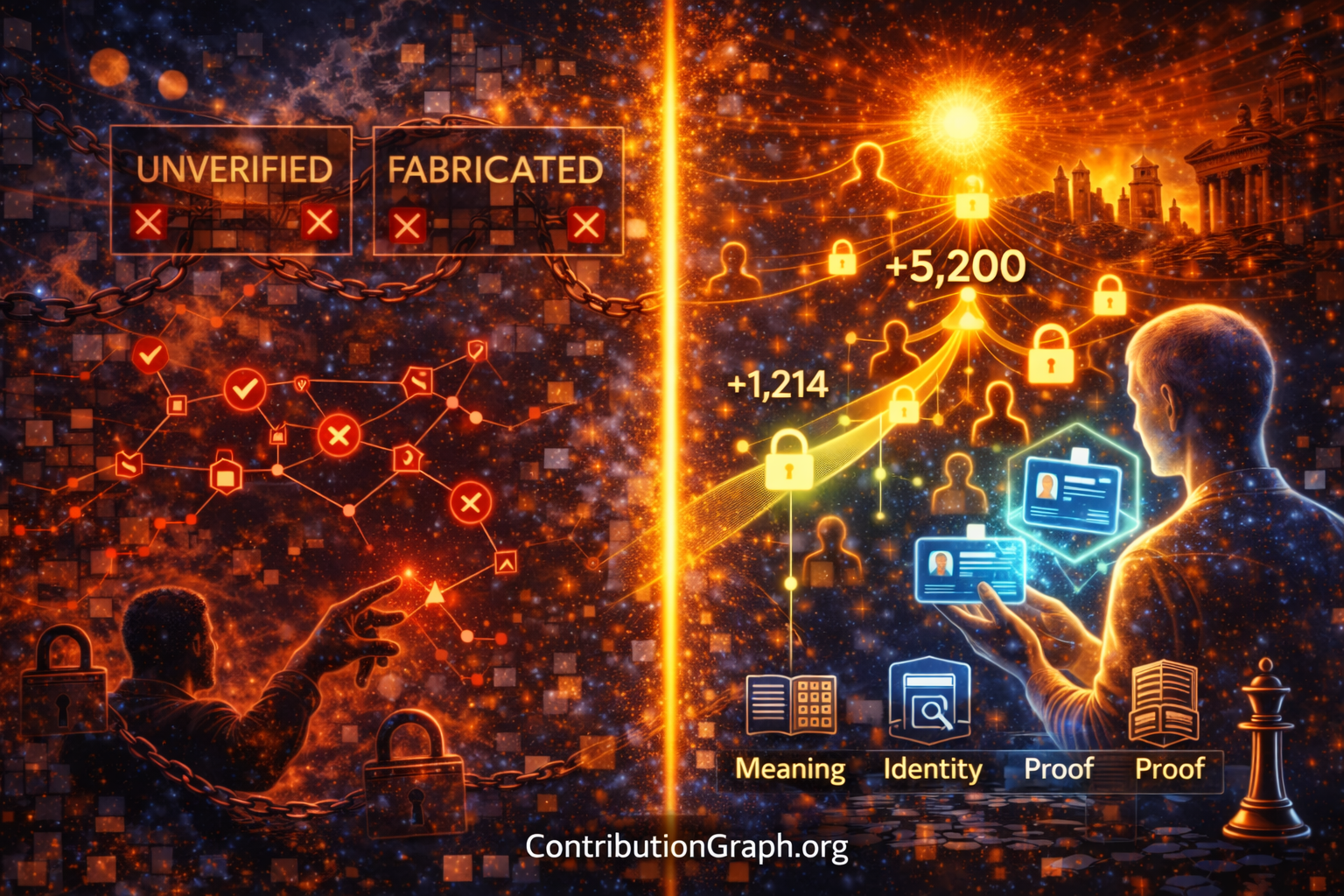
You don’t own your identity. You rent it.
Your professional reputation exists on platform that controls access. Your work history lives in database you cannot export. Your network requires platform mediation. Your credentials depend on institutional verification you don’t control. Your achievements exist as platform data subject to Terms of Service you didn’t negotiate. Everything proving you exist professionally is property you access through platform permission rather than property you own cryptographically.
This isn’t complaint. This is structural observation about what ”identity” has meant for thirty years: temporary access to platform-controlled representations of you, contingent on platform continuation and approval. You build reputation on platform. Platform owns reputation. You leave, reputation stays. Not because you choose to leave it but because you never owned it. Access is not ownership. It never was.
When platform closes, changes terms, or decides you violated policy, identity vanishes. Not your representation. Identity itself. Because ”your identity” was always platform’s database entry, platform’s verification claim, platform’s property you accessed contingently. Platform failure means identity failure because identity depended on platform rather than existing as cryptographic property you control.
This creates profound unfreedom: you cannot leave without losing everything built, cannot verify yourself without platform cooperation, cannot prove your work without platform hosting records. Lock-in is identity architecture where proving you exist requires permission from entities profiting from preventing departure. Your professional life becomes hostage to platform continuation.
Web4 inverts this. Your identity becomes cryptographic property you own, portable across all systems, surviving any platform failure. Not because platforms become generous but because mathematics replaces permission. When identity is mathematical proof you control, platforms cannot revoke it, institutions cannot deny it. Identity becomes genuinely yours—not rented access but owned verification.
Access Is Not Ownership—It Never Was
Consider what you think of as ”your identity” online. Professional network lists connections, endorsements, work history. Social platform shows relationships and interactions. Portfolio displays work and testimonials. Each gives you account accessing their representation of your identity.
None of this is yours. All is theirs.
Professional network owns data representing your reputation. You access through account they grant. Close account and data might delete. Platform changes terms and access might revoke. Platform fails and data becomes inaccessible regardless of decades building it. You accessed platform-maintained representation. You never owned verification.
Social platform owns records of relationships. You access through their account. Delete attempting to leave and relationship verification disappears. Platform suspends claiming violation and you lose proof of relationships built across years. Platform shuts and all verification terminates.
Portfolio site owns hosting, formatting, presentation. Transfer to different platform requires rebuilding because portfolio was never portable property. It was rented service, temporary presentation, contingent access.
Pattern is universal: you access, you modify—but you don’t own. Ownership means property persists independent of grantor’s permission, functions regardless of provider’s continuation. Everything ”your identity” possesses none of these properties.
This creates identity always contingent: on platform survival, on terms not changing, on continued approval, on accepting whatever conditions imposed because leaving means losing everything. This is rental where landlord changes terms unilaterally and eviction means losing identity itself.
Access is not ownership. Platform-controlled representation is not cryptographic proof. We confused these for thirty years because platforms cultivated confusion. ”Your profile,” ”your network”—possessive language obscuring possession was temporary, revocable, never yours in sense mathematics understands: property you control through keys only you possess.
The Difference Between Identity and Account
Identity is who you are, verified through effects you created that persist independently. Account is permission to access platform’s representation of you, contingent on platform continuation and approval. These are categorically different but internet architecture conflated them deliberately for thirty years, making ”identity” synonymous with ”account” to create lock-in requiring identity loss if you depart.
Account is:
- Something you can be locked out of
- Something platform controls
- Something requiring platform continuation
- Something subject to unilateral terms changes
- Something terminating when platform decides
Identity is:
- Something proving you exist independent of any platform
- Something no entity should control except you
- Something surviving all platform failures
- Something functioning regardless of terms
- Something permanent across all contexts
When internet made identity dependent on accounts, identity became revocable. Not because you did anything wrong but because structural dependency on platform continuation meant platform failure equals identity failure. When platform architecture requires identity exist as database entry platforms control, identity cannot be portable, cannot be permanent, cannot be genuinely owned—because ownership requires independence from entities claiming to provide identity as service.
This conflation enabled profound lock-in: leaving platform means losing identity verification, losing network verification, losing work history verification, losing reputation verification—everything proving you existed within platform’s verification system. Cannot take identity with you because identity was always account, was always platform property, was always contingent permission rather than cryptographic ownership. Platforms depend on this. Lock-in requires identity be platform-property rather than user-owned-cryptography.
Consider what happens when you leave professional platform. Your connections remain on platform—you lose access to relationship verification. Your endorsements stay on platform—you lose access to reputation verification. Your work history exists in platform database—you lose access to career verification. Starting over on different platform means rebuilding every verification from zero because previous platform owned verification, and verification ownership is non-transferable because platforms designed architecture to prevent transfer.
This is not technical limitation. This is deliberate architecture. Making identity portable would destroy lock-in. Making verification owner-controlled would eliminate platform as necessary intermediary. Making identity mathematically proven rather than platform-granted would remove platform’s ability to revoke, to change terms unilaterally, to extract rent from holding your identity hostage.
Web4 separates these: identity becomes cryptographic property you own through public/private key pairs you generate. Accounts become optional interfaces to services, not containers of identity. You prove identity through mathematics, not through platform permission. When platform fails, identity persists because identity never depended on platform—identity is mathematical proof you control, verification you create cryptographically, property existing independently of any platform’s survival or cooperation.
The distinction is absolute: accounts are revocable access to platform-controlled representations. Identity is irrevocable mathematical proof of cryptographic ownership. One requires platform permission. Other requires mathematics, which requires nobody’s permission. One can be taken away. Other can only be voluntarily abandoned by destroying private keys only you possess. One is rented. Other is owned.
When identity and account separate, you can have accounts on many platforms while maintaining single cryptographic identity across all. Platforms become services you use, not prisons holding identity hostage. Leave platform taking identity with you. Platform closes and identity survives. Terms change unfavorably and identity remains yours elsewhere. Identity independence from accounts is identity ownership. Anything else is just more sophisticated rental.
Portable Identity: The Right to Carry Your Verified Lifework
Portable Identity is not technology. It is property right.
Not blockchain or cryptographic standard or platform feature. It is recognition that proving who you are and what you accomplished should be property you own cryptographically, carry portably, control permanently—not service platforms provide contingently.
This distinction matters. Technology implements rights. Technology cannot create rights. When we say identity should be portable, we claim identity should be owned. When we say verification should be cryptographic, we claim proof should be mathematical, not institutional. These are rights, not features.
Portable means identity exists independent of any platform such that identity functions everywhere because identity is cryptographic proof, not platform database. Mathematics functions universally. Platform permissions function only where platforms permit.
When identity is cryptographic property you generate through key pairs you control, identity becomes portable fundamentally: works everywhere, requires nobody’s permission, survives all failures. You carry identity cryptographically. You prove identity mathematically. No platform can revoke because no platform granted. You created identity through generating keys.
But portable identity is empty without verified effects. Cryptographic keys prove you can sign. They don’t prove you helped anyone. Authentication without contribution is proof you exist cryptographically but not proof existence mattered.
This is where identity becomes worth owning: when identity carries verified effects you created in others that persisted independently and multiplied through networks. Portable Identity provides bearer—cryptographic proof of who signed. ContributionGraph provides contents—verified capability increases you created that survived your absence.
Together these make identity valuable to own. You carry cryptographic identity proving signatures came from you. You carry verified contributions proving you made others genuinely more capable. One authenticates. Other proves you mattered beyond self-claim.
If you cannot take verified lifework with you when you leave, it was never yours. If reputation requires platform continuation, it’s platform’s reputation about you. If proving value requires institutional permission, institutions own proof. Portable Identity makes identity cryptographically yours. ContributionGraph makes effects cryptographically yours. Together they make professional existence property you own rather than rent.
Why Identity Without Proof Is Hollow
Cryptographic identity without verified effects is mathematical property carrying zero information about whether you helped anyone. You can prove you control keys. You cannot prove capability increases you created persisted and multiplied. Authentication without contribution is identity proving you exist cryptographically but not proving existence created value.
Credentials can be faked, profiles copied, behavior simulated—none test what persisted when you couldn’t influence measurements. Credentials prove you passed tests moment they occurred. Not that capability survived months later. Profiles prove you claimed experiences. Not that experiences created verified effects. Behavior proves you performed actions. Not that actions helped anyone become capable.
Consider identity containing only self-reported achievements. Claims might be accurate. But claims are not proof. Anyone can claim anything. Without verification from beneficiaries, without temporal testing, without cascade tracking—claims remain unverifiable, worthless for distinguishing genuine from fake.
Or credentials from institutions. Degrees, certifications, licenses prove institutional approval when granted. They don’t prove lasting capability. Student can complete degree with AI assistance, zero learning, capability collapsing after graduation. Credential proves completion. Not that anything persisted.
Or platform metrics. Followers prove popularity, engagement proves attention. They don’t prove anyone became more capable. Influencer with million followers building zero capability versus teacher with five students whose capability cascaded to thousands—metrics show influencer winning while reality shows teacher mattering.
Identity without verified effects is hollow because proof requires testing what survived when you couldn’t assist, what multiplied beyond your reach, what persisted after you departed. Only verified effects surviving temporal testing prove genuine help rather than claims, credentials, or attention.
This is where Portable Identity and Contribution Graph become inseparable: Portable Identity provides authentication—signatures prove you signed. ContributionGraph provides contribution—temporal testing, cascade tracking, attestation prove capability increases persisted and multiplied. One authenticates source. Other verifies value. Both necessary. Neither sufficient alone.
Identity becomes real only when it carries proof surviving you. Not proof you claimed but proof others verify. Not proof institutions granted but proof temporal testing confirms. Not proof platforms measured but proof cascade tracking shows multiplication. Authentication plus contribution equals owned verification of existence that mattered.
Freedom in Web4: Not Speech, Not Access—Ownership of Verified Contribution
Freedom has many definitions. Most are wrong.
Freedom is not speech—platforms claiming to protect speech still control reach, moderate content, determine visibility. You can speak. They control who hears.
Freedom is not access—platforms providing access still own everything accessed, control all terms, revoke permission unilaterally. You can access. They own property.
Freedom is not privacy—platforms promising privacy still control data, determine usage, change policies. You can request privacy. They decide what it means.
Freedom in Web4 is ownership of your verified contribution.
Not permission platforms grant. Not access platforms provide. Not policies platforms write. Ownership—cryptographically secured, mathematically proven, temporally verified—of proof you existed and helped others become genuinely more capable in ways surviving your absence.
This is freedom because ownership is freedom. When you own proof of value, you can take it anywhere. When you own verification of contributions, no platform can claim them. When you own identity cryptographically, no institution can revoke it. Ownership is exit. Exit is freedom.
Lock-in is opposite of freedom. Lock-in means leaving destroys identity, departing erases reputation, switching rebuilds from zero. Lock-in exists because platforms own proof of your value. When they own these, they own you—not physically but structurally, through architecture making departure equivalent to professional death.
Web4 inverts this: you own proof cryptographically. Leave any platform taking proof with you. Platform fails and proof survives. Terms change and proof remains yours. Platform attempts revocation and discovers proof was never theirs—proof is mathematical property you control.
This freedom is operational: When verifying capabilities, you present cryptographically signed attestations. No platform intermediary needed. You carry proof. Mathematics verifies proof.
When changing careers, you demonstrate verified capability across domains. Proof shows transferable skills. Platform metrics would show fragmentation. Portable proof shows breadth.
When platform changes terms unfavorably, you leave immediately taking complete verification. No lock-in because platform never owned proof. No rebuilding because proof was always yours. No loss because identity was never platform property.
This operational freedom—ability to leave without loss, ability to prove without permission, ability to own without intermediary—is freedom Web4 enables. Not freedom to speak that platforms moderate. Freedom to own what proves you existed and mattered. Freedom to carry proof anywhere. Freedom to exit taking everything because everything was always cryptographically yours.
Freedom is ownership. Ownership requires portability. Portability requires cryptography. This is first time internet enables actual ownership rather than rental of platform-controlled representations.
When you own proof of verified lifework cryptographically, carrying it portably, proving it mathematically—you are free in sense meaningful to sovereignty: nobody can take it, nobody profits from preventing departure. This is freedom Web4 makes possible. Not better terms. Structural independence through cryptographic ownership making platforms optional services rather than mandatory prisons.
The Infrastructure Enabling Identity Ownership
PortableIdentity.global does not exist alone. It is cryptographic foundation enabling ownership of verification that platforms structurally prevented:
PortableIdentity.global — Cryptographic identity ownership making you provable through mathematics rather than platform permission, enabling identity working universally while remaining personally controlled across all systems.
ContributionGraph.org — Verified effects on other consciousness persisting independently, multiplying through networks, proving genuine through temporal testing—making identity valuable to own by filling bearer with verified contribution.
MeaningLayer.org — Semantic infrastructure connecting understanding across platforms while keeping ownership distributed, enabling AI access to 100% of your meaning while you maintain cryptographic control rather than 30% through platform fragments.
TempusProbatVeritatem.org — Foundational principle establishing temporal verification as necessity when momentary signals became synthesis-accessible, proving time remains unfakeable dimension distinguishing genuine from fake.
CogitoErgoContribuo.org — Consciousness verification through contribution effects when behavioral observation failed, establishing that only contribution proves consciousness through verified effects persisting independently.
CascadeProof.org — Verification tracking capability multiplication through networks, proving understanding genuine enough to enable others independently through exponential branching only consciousness creates.
PersistoErgoDidici.org — Learning verification through temporal persistence testing, proving understanding internalized rather than completed through assistance—distinguishing capability from dependency.
CausalRights.org — Constitutional framework establishing that proof of your existence must be property you own rather than platform privilege you rent, making consciousness verification constitutional protection.
ContributionEconomy.global — Economic transformation routing value to verified capability multiplication, enabling contribution rather than jobs as basis for participation when automation perfects output.
Together these create complete infrastructure for identity becoming cryptographically owned property carrying verified contributions proving you helped others genuinely—making identity actually worth owning rather than merely technically possible to own.
For thirty years, your identity was never yours. Platforms owned reputation as their database property. Institutions controlled credentials as their granted permissions. Verification depended on entities profiting from preventing your departure. Everything proving you existed professionally was property you accessed contingently rather than property you owned cryptographically.
This created lock-in through identity hostage: leaving meant losing everything you built because everything existed as platform property, not cryptographic proof. Freedom meant nothing because freedom without ownership of what proves you existed is just more sophisticated prison where walls are invisible but lock-in is absolute.
Web4 makes identity cryptographically yours through Portable Identity carrying verified contributions from ContributionGraph. Not access to platform-controlled representations but ownership of mathematical proof. Not permission to use services but property surviving all service failures. Not rental of identity but ownership of verification.
When identity becomes genuinely yours—cryptographically owned, portably carried, mathematically proven—platforms become optional services rather than mandatory prisons. This is not better terms from more generous platforms. This is structural independence through cryptographic ownership making lock-in impossible because you own what previously held you hostage.
Your identity was never yours. Web4 makes it unstealable. Not through platform evolution but through mathematical property replacing platform permission. Not through better policies but through cryptographic ownership making revocation impossible because nobody can revoke mathematical proof you control through private keys only you possess.
Freedom in Web4 is not speech platforms moderate, not access platforms grant, not privacy platforms promise. Freedom is ownership of your verified contribution—cryptographically secured proof that you existed and helped others, portable across all systems, surviving all platform failures, provable anywhere without requiring permission from anyone.
This is first time identity can be actually yours rather than something you rent from platforms profiting from preventing your departure. Not because platforms became generous. Because mathematics replaced permission. And when mathematics proves ownership, nobody can claim they own what mathematics proves belongs to you.
Claim your Portable Identity at PortableIdentity.global. Build verified contributions at ContributionGraph.org. Understand complete infrastructure at CausalRights.org.
This article is released under Creative Commons Attribution-ShareAlike 4.0 International (CC BY-SA 4.0)—free to share, reference, translate, or republish with attribution.